Chorographic Freestyle

REGULATIONS – FREESTYLE CHOREOGRAPHIC SECTION

ART. 1 – DESCRIPTION OF THE DISCIPLINE

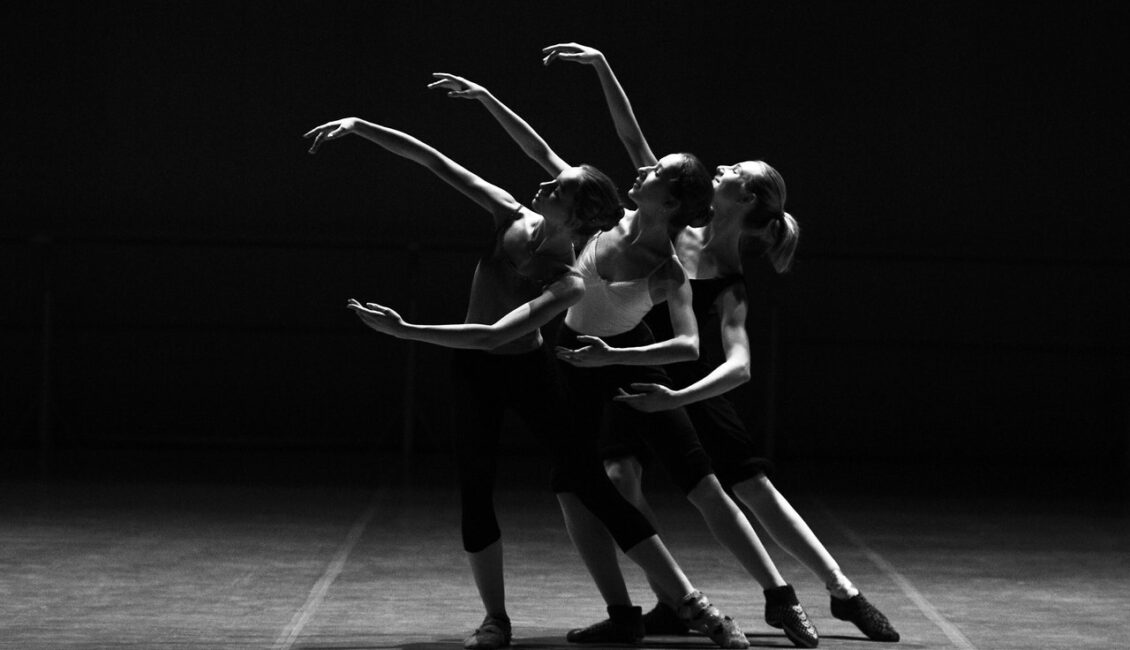
The Freestyle Choreographic section includes all disciplines that combine body expression and choreographic construction, enhancing synchronization, technique, and artistic interpretation.
The following disciplines are included:

  • Synchro Dance

  • Synchro Latin

  • Synchro Duo

  • Choreographic Dance

  • Show Dance

ART. 2 – SYNCHRO DANCE

This discipline requires the perfect synchronization of movements, steps, and figures performed to a freely chosen piece of music.
Emphasis is placed on interpretation, expressed through body language, and on the fluidity of the choreographic development, performed with adequate technical and athletic ability.

ART. 3 – SYNCHRO LATIN

All dance styles and musical genres related to Latin American and Caribbean dances are allowed.
Evaluation focuses on interpretation, musicality, and quality of movement, performed in perfect synchronization.

All team members must execute identical movements and steps simultaneously and in the same directions, maintaining formation from the beginning to the end of the routine.

The last 10 seconds may be used to conclude the choreography with a free-form variation.
Lifts or physical contact between dancers are not permitted (except in the final section).
No person outside the team may enter the floor, and the use of scenic elements is prohibited.

ART. 4 – SYNCHRO DUO

A discipline derived from Synchro Dance, open to duos consisting of:

  • male/female

  • two females

  • two males

The two partners must perform identical movements and steps in synchronization, without physical contact or variation in form.

ART. 5 – CHOREOGRAPHIC DANCE

This discipline is considered the natural evolution of synchronized dance.
All dance styles and musical genres are permitted.

In addition to interpretation and fluidity, evaluation also considers choreographic composition, spatial management, and modular structure.
Teams must begin their choreography already divided into different modules, developing group formations through structured divisions.
Synchronized modules are not allowed.

During the performance:

  • Lifts and contact are not allowed.

  • It is forbidden to throw or place any objects on the floor, even if part of the costume.

  • The last 10 seconds of the performance may be performed freely.

  • Any scenic or unapproved materials are strictly forbidden.

ART. 6 – SHOW DANCE

This discipline uses a free choreography to develop a theme or storyline.
It may portray emotions, daily life, musicals, or films interpreted through dance.

Show Dance is not subject to the limitations of the Synchro and Choreographic Dance disciplines.
The choreography must express a coherent theme through:

  • Music – rhythm, melody, and dynamics

  • Choreography – originality and creativity in movements and thematic development

  • Gestures – body expression and mime

  • Costumes – coherence and elegance consistent with the theme

  • Makeup – appropriate to the interpretation

Theme, costumes, and makeup must always be appropriate to the age of the dancers.

Functional scenic props (e.g., chairs, backdrops, small accessories) are permitted only if:

  • relevant to the theme,

  • brought on and removed by the performers themselves,

  • not electric or electronic.

The use of external people, animals, motor vehicles, or electrical/electronic devices is strictly prohibited.
Evaluation focuses solely on the choreographic performance, not on scenic effects.

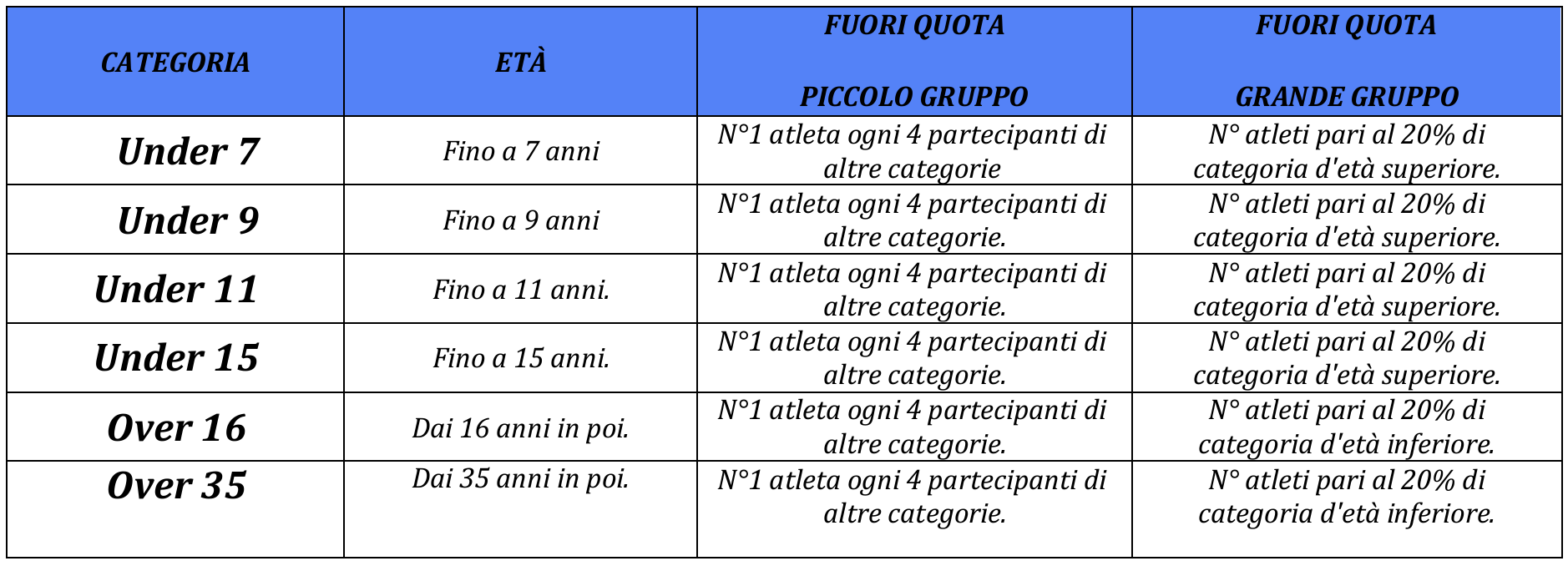
ART. 7 – COMPETITIVE UNITS

  • Duo – 2 performers (Synchro only)

  • Small Group – 3 to 8 performers

  • Large Group – 9 or more performers

ART. 8 – AGE CATEGORIES

The age categories are as follows:

  • Promotional: 6–7 years

  • Mini: 8–9 years

  • Youth: 10–12 years

  • Junior: 13–16 years

  • Adults: 17–25 years

  • Senior: 25+

The group’s category is determined by the average age of its members.
For Duos, the age of the older dancer is taken as reference.

ART. 9 – GROUP CLASSES

  • Class D: reserved for teams whose members have been dancing for less than two years.
    Dancers of a higher level are not allowed to participate.

ART. 10 – MUSIC DURATION

  • Synchro Duo: 2’15’’

  • Synchro Latin: 2’30’’

  • Choreographic Dance: 3’00’’

  • Show Dance: 3’30’’

A 15-second tolerance beyond the maximum duration is allowed.
After this limit, the music will be automatically stopped.

ART. 11 – MUSIC SELECTION AND SUBMISSION

Music selection is free.
👉 Music must be uploaded via the choreography form that the secretariat will send to all participants who have completed registration.
Files must be in .mp3 format and named as follows:
discipline_school-name_choreography-title.mp3

It is recommended to bring a backup copy on USB.

ART. 12 – COSTUMES

Costumes are free, provided they respect decency standards (adequate coverage of intimate areas).
In youth categories, makeup must be discreet (more accentuated only for Show Dance).

ART. 13 – GENERAL COMPETITION RULES

  • A dancer may not compete against themselves.

  • Each school may present multiple groups, provided that no dancer participates in more than one formation within the same class, category, and discipline.

  • Failure to comply with the regulations or any form of misconduct may result in penalties or immediate disqualification by the Competition Director.

  • Upon receiving three penalties (FP), the group will be moved to the last position in the final ranking.

  • Participation is reserved exclusively for students

Event Details
  • Days
    Hours
    Min
    Sec
  • Start Date
    December 6, 2025 10:00 am
  • End Date
    December 8, 2025 6:00 pm
  • Status
    Upcoming
  • Address
    51016, viale Giuseppe Verdi 45
JURY
Event Details
  • Days
    Hours
    Min
    Sec
  • Start Date
    December 6, 2025 10:00 am
  • End Date
    December 8, 2025 6:00 pm
  • Status
    Upcoming
  • Address
    51016, viale Giuseppe Verdi 45
Sponsors